
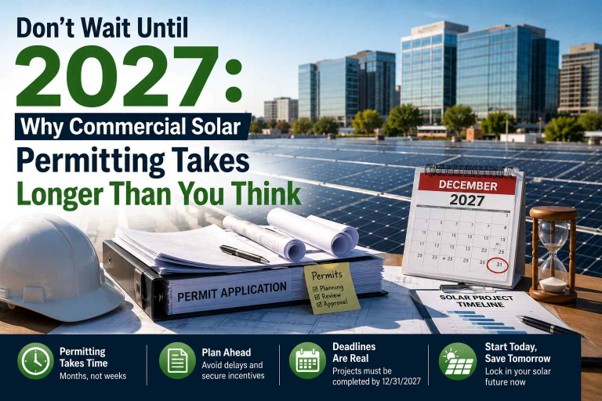
Don’t Wait Until 2027: Why Commercial Solar Permitting Takes Longer Than You Think

The clock is ticking, and it moves faster than most business owners realize. Commercial Solar Permitting is not a quick stamp-and-go task. It’s a maze of city rules, utility checks, and paperwork that can eat months off your timeline. At California Solar, we’ve seen owners rush in late and lose out on real savings. Here’s the full picture, laid out plain and simple.

Why the Rush? The ITC Deadline You Can’t Ignore

The federal solar Investment Tax Credit (ITC) drops away for many projects after December 31, 2027. Right now, businesses can lock in the full 30% credit, plus a 10% domestic content adder if the system uses enough U.S.-made parts. To qualify, your project must meet placement-in-service rules or the “commence construction” rule, and it must follow FEOC (Foreign Entity of Concern) requirements, too.

Here’s the catch. These rules aren’t just about flipping a switch on your panels. You need real proof of progress, and that proof takes time to build. Waiting until next year to start could mean missing the window entirely.

How Long Does Commercial Solar Permitting Take?

This is the question every business owner asks, and the honest answer is: it depends, but rarely fast. A commercial solar installation timeline can stretch anywhere from four months to over a year, based on your city, your utility, and the size of your system.

Small rooftop jobs in solar-friendly counties may wrap up in three to four months. Bigger ground-mount systems, or projects that need structural upgrades, can take nine to twelve months from design to final approval. Add utility interconnection on top, and the wait grows longer still.

Why Commercial Solar Permits Take So Long

A lot of folks think permitting is just filling out a form. It’s way more layered than that. Here’s what stacks up the clock:

  • Plan review backlogs. Building departments juggle stacks of applications, and yours sits in line behind everyone else’s.
  • Structural and electrical review. Engineers must confirm that your roof or land can handle the load, and your wiring meets code.
  • Fire and safety checks. Local fire marshals often require setback paths and rapid shutdown systems before sign-off.
  • Multiple agencies. City, county, state, and utility each have their own process, and none of them move at the same speed.
  • Revisions and resubmittals. One missing detail can bounce your application back, adding weeks to the wait.

None of this means you should give up on speed. It means you need a partner who knows the system inside and out.

What Permits Are Required for a Commercial Solar Installation?

Before your panels ever touch a roof, you’ll need to clear a checklist of approvals. A solid commercial solar permitting checklist typically includes:

  1. Building permit – covers structural and electrical work tied to the installation.
  2. Electrical permit – confirms wiring, inverters, and panel connections meet code.
  3. Zoning approval – checks your project fits local land-use rules.
  4. Fire department review – verifies safety clearances and shutdown access.
  5. Utility interconnection agreement – gives you the green light to connect to the grid.
  6. Environmental review – applies to larger ground-mount or land-disturbing projects.

Missing even one step can stall your entire project, so a full checklist review upfront saves real headaches down the road.

What Slows Down the Commercial Solar Approval Process?

Beyond the permits themselves, a few common snags trip up businesses again and again:

  • Incomplete engineering drawings submitted too early
  • Utility grid capacity limits in your area
  • Outdated site surveys that don’t match current conditions
  • Financing gaps that delay the project scope from being locked in
  • Equipment lead times for panels, inverters, or battery systems

Smart planning around Commercial Solar Financing early in the process helps avoid last-minute scrambling. Locking in your budget and equipment list before permitting starts keeps your application clean and moving.

Read More : Why Commercial Solar Projects Need Materials Delivered Before July 4, 2026

Battery Storage Adds Value, But Needs Its Own Review

More businesses now pair their systems with Battery Energy Storage Solutions to cut demand charges and keep power flowing during outages. Storage adds real value, but it also adds another layer to your permitting file. Batteries often require a separate fire safety review and additional electrical inspection, so build that extra time into your plan from day one.

Working With the Right Partner Matters

Not every installer handles the paperwork with the same skill. A trusted Business Solar Installation Company brings relationships with local building departments, knows which utilities move slowly, and can flag issues before they become delays. California Solar has guided projects of every size through this maze, and we build permitting timelines around real deadlines, not guesswork.

Don’t Let 2027 Sneak Up on You

The full 30% ITC, plus the domestic content adder, won’t stick around forever. FEOC rules and construction deadlines add more layers to sort through, and permitting alone can chew up months of your runway. California Solar is ready to map out your full commercial solar installation path today, from permits to interconnection to the last inspection. Reach out to our team and let’s lock in your savings before the window closes.

FAQs

Q1: How long does commercial solar permitting take?

Permitting can take four months to over a year, based on system size, city rules, and utility speed. Larger or ground-mount projects almost always take longer than small rooftop installs, so start early to protect your timeline.

Q2: Why do commercial solar projects take longer than expected?

Multiple agencies review your project separately, and each one has its own pace. Structural checks, fire safety review, and utility approval all stack up, and one missing document can send you back to the start.

Q3: What permits are required for a commercial solar installation?

You’ll typically need a building permit, electrical permit, zoning approval, fire department review, and a utility interconnection agreement. Larger projects may also require environmental review before construction can begin.

Q4: What causes delays in commercial solar permitting?

Incomplete drawings, outdated site surveys, equipment lead times, and grid capacity limits are common culprits. Financing gaps can also stall a project if the scope isn’t locked in before the application goes out.

Q5: How long does utility interconnection take for commercial solar?

Utility interconnection alone can take two to six months, depending on grid capacity and study requirements. Larger systems needing upgrades to local infrastructure often face the longest waits in this step.

The 2027 Solar Tax Credit Deadline Explained for Commercial Property Owners

Commercial property owners across California face a real deadline. The federal government set December 31, 2027, as the cutoff for the full 30% solar tax credit under the Investment Tax Credit program. This window will not stay open forever, and waiting too long could cost your business real money. The 2027 Solar Tax Credit Deadline marks a turning point for anyone who owns warehouses, office buildings, retail centers, or industrial facilities. Below, we break down what this deadline means, who qualifies, and why acting now protects your bottom line.

What Is the 2027 Solar Tax Credit Deadline?

The solar Investment Tax Credit (ITC) lets commercial property owners claim 30% of their solar installation cost as a federal tax credit. Congress set the expiration date for December 31, 2027. After this date, the credit could shrink or disappear for new commercial solar projects.

This is not a small change. A property that installs a solar system before the deadline locks in savings equal to nearly a third of the total project cost. Owners who wait past 2027 risk losing this benefit for good.

Commercial Solar Tax Credit Explained: How the Rules Work

It can be explained in the two paths for qualifying: placement in service and commencement of construction.

Placement in Service Rule

This rule says your solar system must be fully installed and running before the deadline hits. The system needs to generate power and connect to the grid, not just stand half-built on your roof.

Commence Construction Rule

This second path gives a bit more breathing room. If your project starts construction before the deadline and stays on a steady build schedule, it can still qualify even if it finishes later. Physical work on-site or a signed contract with a five percent cost commitment can count as the start.

Both paths give property owners real flexibility, but the clock keeps ticking either way.

Read More : How to Lock In the 30%–50% Solar ITC Before the July 4, 2026, Deadline

Do Commercial Properties Qualify for Solar Tax Credits?

Not every project looks the same, but the answer stays fairly simple for most commercial buildings. Yes, if they meet a few basic conditions:

  • The property must be used for business purposes, not a personal residence
  • The solar system must be new equipment, not used or refurbished
  • The owner must follow IRS guidelines for depreciation and credit claims
  • Foreign Entity of Concern (FEOC) requirements must be met, meaning certain components cannot come from restricted foreign sources

FEOC rules matter more now than ever. If your equipment or supply chain connects to a restricted entity, your credit could get denied or reduced. A trusted solar provider helps you dodge this pitfall from day one.

The Domestic Content Adder: An Extra 10%

Here is a bonus worth knowing. Projects that use a set share of American-made steel, iron, and manufactured products can qualify for a domestic content adder. This bumps the base 30% credit up by an additional 10%, pushing total savings even higher.

Meeting this bar takes planning. Your solar provider needs to track material sourcing and document it for the IRS. A knowledgeable team makes this process smooth instead of stressful.

Should Commercial Property Owners Install Solar Before 2027?

Short answer: yes, and the reasons stack up fast. Consider these points:

  1. Lock in the full credit: Waiting risks losing the 30% rate entirely
  2. Beat rising demand: Contractors and installers get busier as the deadline nears, and scheduling gets tighter
  3. Protect long-term energy costs: Solar locks in predictable energy expenses for decades
  4. Boost property value: Buildings with solar systems draw stronger interest from tenants and buyers

Property owners who move early gain first pick of installation slots, equipment, and financing options.

Commercial Solar ROI for Property Owners

Commercial solar ROI for property owners depends on a few factors: system size, energy usage, local utility rates, and available incentives.

The math generally works in your favor. Solar systems cut or wipe out monthly utility bills, and the tax credit shortens the payback period by a wide margin. Add depreciation benefits on top, and the return grows stronger each year the system runs.

Commercial solar incentives for businesses stack together, too. State rebates, utility programs, and depreciation schedules can combine with the federal credit for a bigger benefit.

Commercial Battery Storage: A Smart Add-On

Solar panels generate power during the day, but your business might need energy after hours or during an outage. Commercial battery storage solves this gap. Storing extra solar power lets you use it during peak pricing hours or when the grid goes down.

Battery systems also qualify for the same 30% tax credit when paired with solar, making this an easy add-on for property owners planning a system now.

Why California Solar Is the Right Partner

Our team has spent years guiding property owners through the tax credit maze. We have built a strong track record of successful installations across the state, backed by real Commercial Solar Case Studies that show measurable savings and fast payback periods.

Every commercial property has its own energy demands, operational priorities, and financial objectives. Our Commercial Solar Consultation is designed around those unique factors, delivering a tailored strategy that helps maximize energy savings, improve long-term returns, and support smarter business decisions from day one.

Ready to Lock In Your Solar Tax Credit?

The deadline will not wait, and neither should your business. Reach out to California Solar today for a Commercial Solar Consultation and find out exactly how much your property could save before December 31, 2027. Our team is ready to walk you through every step, from FEOC compliance to final installation.

Frequently Asked Questions

Q1: What is the 2027 solar tax credit deadline for commercial properties?

The deadline falls on December 31, 2027. Commercial property owners must meet placement in service or commence construction rules by this date to claim the full 30% federal solar tax credit before it expires.

Q2: Who qualifies for the federal commercial solar tax credit?

Business-owned properties using new solar equipment qualify, provided they meet IRS depreciation rules and FEOC requirements. Warehouses, offices, retail buildings, and industrial sites all count as eligible commercial properties under current federal guidelines.

Q3: Should commercial property owners install solar before 2027?

Yes. Installing before the deadline locks in the full 30% credit, guards against rising installation costs, and secures earlier scheduling. Waiting risks reduced incentives and tighter contractor availability as the deadline approaches.

Q4: How does the federal solar tax credit work for businesses?

The credit lets businesses deduct 30% of solar installation costs from their federal taxes. Meeting placement in service or commence construction rules, along with FEOC compliance, determines eligibility for the full credit amount.

Q5: What expenses are typically eligible for the commercial solar tax credit?

Eligible costs include solar panels, inverters, mounting equipment, labor, and battery storage systems paired with solar. Site preparation and electrical upgrades connected directly to the installation also qualify under current federal rules.