

Is Your California Business Sitting on a 50% Solar Tax Credit? Check Your Energy Community Status

If you’re running a business in California, you could be sitting on a goldmine of clean energy savings—and not even know it. Thanks to recent updates in federal tax law, many businesses now qualify for up to a 50% solar tax credit. The catch? You need to be in an Energy Community to get the full benefit. The good news: most of Southern California qualifies.

At California Solar, we’re helping businesses like yours uncover hidden savings by checking their Energy Community status. Here’s what that means—and why you should care.

What’s an Energy Community?

Energy Communities are regions defined by the U.S. Department of Energy where the economy has been historically tied to fossil fuels. These areas often include:

  • Counties with closed coal plants or retired fossil fuel jobs
  • Zones with high unemployment linked to energy shifts
  • Brownfield sites or areas undergoing environmental cleanups

These communities are now being rewarded for shifting to clean energy, and that reward comes in the form of a 10% federal tax credit bonus on top of the base 30% Investment Tax Credit (ITC).

How Does the 50% Credit Work?

The 30% ITC applies to most commercial solar and battery storage projects. But if your business is located in an Energy Community and you use U.S.-made components, here’s what you could get:

  • 30% base tax credit
  • +10% Domestic Content bonus
  • +10% Energy Community bonus

That’s 50% off your system cost—plus 100% first-year depreciation.

Is Your Business in an Energy Community?

Here’s the wild part: many California businesses are located in qualifying zones and don’t even know it.

The Department of Energy released an interactive Energy Community map (we can help you check it), and it includes areas like:

  • Los Angeles County
  • Orange County
  • San Diego County
  • Ventura County
  • San Bernardino County
  • Riverside County
  • Kern County

If your commercial property is located in an Energy Community, you’re already eligible for the extra 10%Federal tax credit.

What You Need to Qualify

There’s no special application for the Energy Community bonus. If your building address is in a qualifying area, you get the benefit. But here’s what you do need:

  • A project that starts by July 3rd 2026 or completes by 12/31/2027
  • Basic documentation to confirm site location and eligibility
  • IRS Form 3468 – Investment Credit

The experts at California Solar handle this part for you. We’ll run your address, verify your eligibility, and apply every qualifying incentive to your project.

Let’s Talk Numbers

Say your solar and battery project costs $600,000. Here’s how it could break down:

  • 30% ITC = $180,000
  • 10% Energy Community bonus = $60,000
  • 10% Domestic Content bonus = $60,000
  • Total Tax Credit = $300,000

That’s half the system paid for—before depreciation and utility savings even kick in.

Why California Solar?

At California Solar, we focus on commercial solar and battery projects.

Here’s what we bring to the table:

  • Site eligibility checks – We confirm your Energy Community status up front
  • Incentive assistance – We’ll help your tax preparer with tax credit documentation
  • Top-tier design and installation – Built to maximize ROI and long-term performance
  • Battery storage solutions – Add-ons that qualify for the same tax credits

We work with nonprofits, manufacturers, schools, farms, and every type of business in between. If you’ve got a roof or a lot, we’ll make it work for you.

Don’t Miss the Window

This opportunity won’t last forever. The 50% ITC disappears soon. If you’re in an Energy Community, you need to act before time runs out. Let’s find out if your business qualifies—and how much you can save.

The OBBB is destroying solar:

  • Solar projects that start within 12 months of the OBBB are eligible for
  • the full 30% ITC (plus any bonuses); these projects must be completed in 4-years
  • Projects that do not start by 7/3/2026 can utilize 100% of the ITC if placed in service by 12/31/2027
  • Projects that do not begin by 7/3/2026 and are placed in service after 12/31/2027 are ineligible for the ITC

Contact California Solar today for a free Energy Community check and custom savings estimate. We’ll handle the hard stuff. You enjoy the savings.
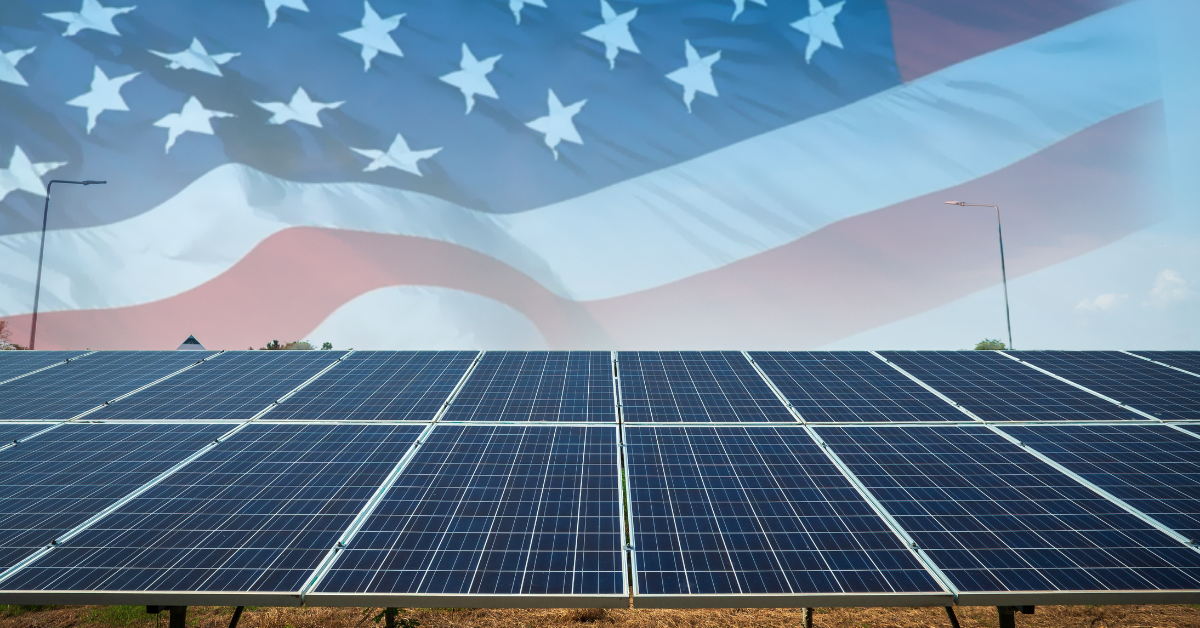
Made in America Pays: How Domestic Solar Components Can Save Your Business an Extra 10%

Going solar is already a smart move for your business. But what if we told you there’s a simple way to stack even more savings on top of the 30% federal tax credit you already get?

If you choose U.S.-made solar panels, inverters, racking, and other key system parts, your business may qualify for an extra 10% tax credit under the Domestic Content Bonus. That’s a huge win—and it’s exactly what the team at California Solar is helping clients unlock right now.

Let’s talk about how it works, what qualifies, and why this bonus could be a game changer for your next commercial solar project.

What Is the Domestic Content Bonus?

Because of the Inflation Reduction Act (IRA), the base federal Investment Tax Credit (ITC)applied to commercial solar projects is 30%. But if you meet certain sourcing requirements by using American-made components, your project can receive an additional 10% credit—bringing your total to 40% before any other adders.

It’s part of a larger push to boost clean energy jobs and manufacturing in the U.S. But from a business perspective, it’s all about keeping more money in your pocket.

What Counts as “Domestic”?

To qualify for the bonus, at least 45% of your solar system’s materials must be made in the U.S. These include:

  • Solar panels (modules)
  • Inverters
  • Racking systems
  • Electrical components like transformers and combiner boxes

In 2025, the threshold is 45%, and it will increase to 50% in 2026. Don’t worry – California Solar keeps up-to-date with these numbers so you don’t have to.

Why It Pays to Plan Ahead

The tricky part? There’s a limited supply of qualifying components—and growing demand. As more companies race to meet the deadline for solar tax credits before they phase down, American-made parts are going fast and prices are going up.

That’s why early planning is key. If you wait too long, you may still be able to go solar—but you might miss out on this extra 10%.

Our team at California Solar works directly with suppliers to lock in qualifying materials early in the process. That way, your project stays on track and on budget.

Do the Math: What an Extra 10% Looks Like

Let’s say your solar installation costs $500,000. Here’s the difference domestic content can make:

  • Base ITC (30%): $150,000
  • Domestic Content Bonus (10%): $50,000
  • Total Credit: $200,000

That’s $50,000 in tax savings just for using U.S.-made components. Add in the energy community bonus and depreciation benefits; the impact grows even bigger.

What if You Combine Bonuses?

Here’s the kicker: this 10% isn’t the only bonus out there. If your business is located in an Energy Community—like most of Southern California—you can stack on another 10% tax credit

That means:

  • 30% Federal ITC
  • +10% Domestic Content
  • +10% Energy Community

= 50% tax credit before you factor in depreciation.

Why Choose California Solar?

At California Solar, we specialize in commercial solar and battery projects. Expert installs and guidance for businesses, nonprofits, and institutions across the state.

Here’s what makes us different:

  • We help you qualify – Our team checks your location, system design, and materials to ensure you’re eligible for every available credit.
  • We do the paperwork – We’ll document your use of domestic components for IRS compliance.
  • We source smart – We prioritize vendors and manufacturers who meet federal requirements for U.S. content.
  • We show you the ROI – Our custom savings reports lay out every penny you’ll save—before you commit to anything.

Final Thought: Made in America Makes a Difference

Going solar already shows your business is thinking ahead. Choosing American-made components? That’s just smart business. With federal support tied to domestic manufacturing, the bonus isn’t just about patriotism—it’s about profits. And right now, that 10% bump is sitting there, ready to be claimed. Let California Solar help you grab it. We’ll walk you through every step, source the right materials, and make sure your project checks all the boxes—on time and on budget.

Ready to see how much you could save with U.S.-made solar? Contact California Solar today and let’s get started.